
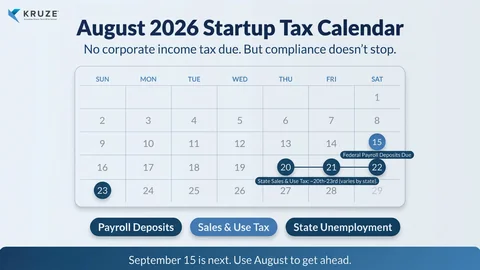
August sits in the middle of Q3 and does not bring major corporate income tax filing dates for calendar‑year C‑corps, but it still includes recurring payroll, sales, and state compliance obligations that matter for growing startups. Founders can use August to stay ahead on employment and transactional taxes, and to keep their compliance up to date heading into the September estimated tax deadline.
Federal: August in the 2026 tax calendar
For most venture‑backed C‑corps, there is no standard federal corporate income tax payment due in August. The third federal estimated corporate income tax installment, covering income earned from June through August, is due on September 15, 2026.
That said, founders should keep an eye on:
- Monthly payroll tax deposits for income tax withholding, Social Security, and Medicare (FICA), which are typically due by the 15th of the following month.
- Routine information and employment reporting that falls throughout Q3, even though the formal “quarterly” federal payroll return (Form 941) is not filed until after Q3 ends.
For startups that are ramping headcount, August is a good time to confirm that payroll systems are correctly handling federal deposits and that those liabilities reconcile to the general ledger.
State-level August obligations: Payroll, sales, and transactional taxes
At the state level, August is mostly a “steady state” month for:
- State payroll and unemployment tax deposits for July wages.
- State sales and use tax filings for monthly filers covering July activity.
- Industry-specific transactional taxes for businesses with monthly reporting cycles.
For example, many states require monthly sales or use tax returns by the 20th or 23rd of the following month, which puts July sales/use activity on an August due date for monthly filers. Quarterly filers, by contrast, will have filed their Q2 returns in July, so August is mainly about staying current on monthly obligations.
Early‑stage startups that rely on payroll providers and sales tax automation often see these filings handled behind the scenes, but founders should still confirm that July and August state deposits match their expectations and that notices are monitored.
City-specific deadlines in August
Across major startup hubs like Austin, Boston, New York City, Palo Alto, San Francisco, Santa Monica, Seattle, Washington DC, Atlanta, Salt Lake City, Mountain View, Chicago, Dallas, Miami, San Jose, Boulder/Denver, and San Diego, there is generally no single, widely‑applicable city corporate income or franchise tax deadline that hits in August for all startups.
Instead, August compliance for these cities is driven by:
- Federal monthly payroll deposits.
- State monthly payroll/unemployment and sales/use tax filings.
- Ongoing local business license or tax obligations that follow annual or quarter‑end cycles earlier in the year.
A few examples of requirements that may affect specific founders, depending on their situations:
- Palo Alto and other California cities. City business taxes and California corporate estimates are concentrated earlier (and again in September); August tends not to add a new city‑specific corporate tax date, but monthly state sales/use or payroll obligations can still apply.
- Austin, Texas. Texas quarterly reports were due in July for Q2; in August, Austin startups mainly handle July payroll and sales tax deposits, plus any ongoing property tax matters if bills are still delinquent.
- New York City and Boston. Complex corporate and business taxes have main return and estimate dates outside August; August is again about monthly state sales/use and payroll deposits for companies with July activity.
How August fits into the 2026 startup tax year
Looking at the full 2026 startup C‑corp tax calendar, August serves as the bridge between mid‑year compliance and the next major corporate estimate:
- Q1 and Q2. Heavy filing months with federal and state income tax returns, Delaware franchise tax, and Q1/Q2 estimates.
- July. Q2 payroll filings and state quarterly returns, plus local business tax items for certain cities.
- August. Steady state, including monthly payroll and sales/use deposits, but no standard corporate income tax due date for calendar‑year C‑corps.
- September 15. Third federal and state corporate income tax estimates for profitable C‑corps.
For founders, this means August is an ideal month to make sure payroll, sales tax, and state compliance are up to date; to review whether profitability trends will trigger larger September estimates; and to clean up any notices or small issues before the fall deadlines arrive.
August 2026 checklist for startup founders
In August, founders should:
- Confirm that July federal payroll deposits (income tax withholding, Social Security, Medicare) were made correctly and reconcile to your books.
- File and pay any state monthly sales/use tax returns due in August for July activity, especially if your startup has nexus in multiple states.
- Check that state unemployment and withholding deposits for July are current and that your payroll provider is aligned with each state’s rules.
- Review Q3 projections to see whether your September 15 estimated corporate income and franchise tax payments need to be adjusted, based on updated burn and revenue trends.
- Use August as a light‑touch compliance month to resolve any IRS or state notices from earlier in the year, rather than letting them pile up ahead of September and October deadlines.
Make August your tax maintenance month
August is the perfect time to clean up payroll, sales tax, and state filings before the next round of estimates hits in September. If you’re not sure which obligations apply to your startup, or want a second set of eyes on your 2026 tax calendar, Kruze’s startup tax CPAs can help you stay compliant without slowing down growth.


