
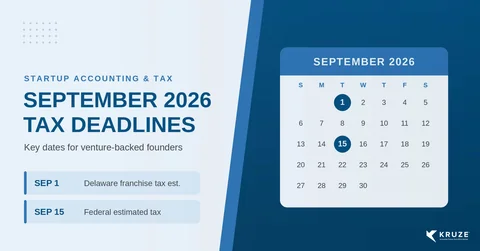
September is a high-priority compliance month for venture-backed startups. For calendar-year C-corps with taxable income, the month brings the third federal estimated tax payment, a Delaware franchise tax installment for qualifying companies, and several important state and local payments.
Even startups that are still operating at a loss should use September to confirm their filings, tax projections, payroll obligations, and local registrations are current. Clean compliance records matter during fundraising, diligence, and acquisition conversations. For complete dates and downloadable calendars, visit our 2026 Startup Tax Deadlines page.
Federal: September 15 estimated tax payment
For profitable calendar-year C-corps, the third federal estimated income tax installment is due September 15, 2026. This payment generally relates to estimated 2026 corporate income tax liability, and it’s part of the standard quarterly estimated-tax cycle that also includes April, June, and January dates.
Your startup may need to make this payment if it expects to owe federal corporate income tax for 2026. Work with your tax advisor to update the forecast using year-to-date revenue, deductions, R&D credit assumptions, and changes in payroll or headcount.
A common mistake is calculating estimates based on an outdated operating plan. If your revenue has accelerated, your margins have improved, or you closed a large contract, revisit your company’s estimated taxable income before September 15.
Delaware C-corps: September 1 franchise tax estimate
Delaware C-corps that expect to owe more than $5,000 in annual Delaware franchise tax have an additional September obligation: A quarterly estimated franchise tax payment due September 1, 2026. The September installment is 20% of the estimated annual Delaware franchise tax amount.
This is separate from federal estimated income tax. Delaware franchise tax is based on a corporation’s structure and capital, NOT its profitability, so even a startup operating at a loss may have an estimated franchise tax obligation.
Founders should confirm that the company’s authorized shares, issued shares, gross assets, and prior Delaware franchise tax calculations are current. Startups with large option pools or multiple financing rounds can see an unexpectedly high calculation if they use the wrong method.
State and city deadlines in September
Several locations have September-specific estimated tax or local property tax dates. The following deadlines may apply depending on where your startup operates, employs people, owns property, or has tax nexus.
| Location | September 2026 deadline | Who should pay attention |
|---|---|---|
| Boston / Massachusetts | September 15: Massachusetts Q3 Corporate Estimated Tax, Form 355-ES; Kruze’s calendar identifies this installment as 25% of estimated tax | Startups with Massachusetts corporate excise tax liability |
| New York City | September 15: New York State and New York City Q3 estimated tax payment | Companies with New York State or NYC corporate tax obligations |
| Washington, DC | September 15: Q3 DC Estimated Tax, Form D-20ES; the second half of the DC real property tax bill is also due | DC-nexus startups and businesses that own DC real property |
| San Francisco | September 1: Delaware franchise tax estimate for qualifying Delaware C-corps; September 15: federal estimated tax installment | San Francisco startups with federal taxable income or qualifying Delaware franchise tax liability |
| Seattle | September 1: Delaware franchise tax estimate for qualifying Delaware C-corps; September 15: federal estimated tax installment | Seattle startups with federal taxable income or qualifying Delaware franchise tax liability |
| Austin | September 1: Delaware franchise tax estimate for qualifying Delaware C-corps; September 15: federal estimated tax installment | Austin startups with federal taxable income or qualifying Delaware franchise tax liability |
| Palo Alto | September 1: Delaware franchise tax estimate for qualifying Delaware C-corps; September 15: federal estimated tax installment | Palo Alto startups with federal taxable income or qualifying Delaware franchise tax liability |
Massachusetts: Corporate estimated tax
Boston startups with Massachusetts corporate excise tax liability should plan for the September 15 Form 355-ES payment. The Q3 installment is 25% of the company’s estimated Massachusetts tax.
This can be easy to overlook if your company’s federal tax estimate is low, but its Massachusetts apportionment or state-specific tax position is different. Coordinate federal and Massachusetts projections together, rather than treating them as separate exercises.
New York City: State and city estimates
New York City-based companies may have both New York State and New York City estimated tax obligations due September 15. These payments are distinct from the federal corporate estimate and can apply to startups with taxable activity in the state or city.
Because New York business taxes can involve multiple filings and allocation rules, confirm whether your company has activity, employees, revenue, or other nexus factors that require state or city estimated payments.
Washington, DC: Estimated tax and property tax
Washington, DC startups with corporate franchise tax liability should calendar the Q3 estimated tax payment on Form D-20ES for September 15. Companies that own DC real property should also note that the second half of the real property tax bill is due on the same date.
If your company rents office space, verify whether property taxes are included in lease charges or passed through separately. If your startup owns equipment or real estate, make sure the tax liability is reflected in the company’s cash forecast and financial statements.
What about California startups?
For startups in California hubs, including Palo Alto, San Francisco, Santa Monica, Mountain View, San Jose, and San Diego, the key September deadline is generally the September 15 federal estimated tax payment, along with the September 1 Delaware franchise tax estimate for corporations above the relevant threshold.
Most California-specific corporate return and business property filing deadlines occur earlier in the year, while the next major San Francisco local installment is the Q3 gross receipts tax payment due in late October. Santa Monica founders should also make sure their annual business license renewal was filed by the August 31 penalty deadline before moving into September planning.
September 2026 startup tax checklist
Use this checklist to keep the month on track:
- Confirm whether your startup owes the September 15 federal estimated corporate income tax installment.
- If you are a Delaware C-corp expecting annual franchise tax above $5,000, pay the September 1 installment – 20% of your estimated annual amount.
- If you operate in Massachusetts, New York City, or Washington, DC, confirm whether a September 15 state or local estimated tax payment applies.
- For DC real estate owners, plan for the September 15 second-half property tax payment.
- Update your tax forecast using year-to-date actuals before making payments.
- Reconcile all tax payments in your accounting system and document the assumptions supporting each estimate.
- Begin preparing for October deadlines, including extended federal and state corporate returns for startups that filed extensions.
Make September a planning month
September is more than a payment deadline. It’s a useful point to pressure-test your full-year forecast. By late Q3, founders typically have enough actual financial data to reassess taxable income, evaluate cash needs, and identify potential compliance issues before October’s extended-return deadline.
Need help with your September tax obligations? Kruze’s startup accountants and tax CPAs help venture-backed companies build tax forecasts, manage multi-state obligations, and keep financials ready for investors and diligence.


