
SAFE notes are one of the preferred investing instruments in the startup world. SAFE (simple agreement for future equity) notes are an alternative to convertible notes, and SAFE notes are less complex.
They are basically an agreement that allows investors to purchase equity in a startup at a negotiated price now, and the investor will receive the equity at some point in the future (called conversion). There’s no set time for conversion – it will happen when and if the company next raises capital.
With that in mind, how do startups account for a SAFE note investment? Let’s look at some important accounting points.
Don’t let messy SAFE accounting stall your next round. Ensure your books are audit-ready for investors with Kruze’s VC Due Diligence services.
A SAFE is equity, not debt
In practice, most venture‑backed startups and their investors treat standard SAFE notes as equity‑like instruments, and Kruze generally presents them in the equity section of the balance sheet. This has important ramifications for investors who are trying to take advantage of the Qualified Small Business Stock (QSBS) exclusion, which can provide significant tax savings for qualified investments that are held for at least five years, based on when the stock was issued.
With SAFEs, the QSBS holding period for the actual stock generally starts on the date the SAFE converts into preferred or common shares, not when the SAFE is first issued, which is important for founders and early investors to understand. Recently some SAFEs have incorporated debt‑like terms (for example, provisions that mimic liquidation preferences or repayment on a sale), which can make the classification analysis more complex, but from a practical “what will my VCs expect to see?” standpoint, we still present standard early‑stage SAFEs as equity for most startups.
Accounting entries for SAFE investment
When funds come in from a SAFE note, they are added to cash as a debit. We also credit the SAFE notes line item in your balance sheet. Since SAFE notes don’t have a maturity date, they don’t have to be paid back in 12 or 24 months.
From a presentation standpoint, we usually label this as “SAFE Notes Outstanding” in the equity section to match what sophisticated venture investors expect to see on a startup balance sheet. Under GAAP, however, companies and their auditors still need to evaluate the specific terms of each SAFE to determine whether it should be classified as equity or as a liability.
Journal entries when a company receives a SAFE
- Debit: Cash (an asset account) to reflect the inflow of funds.
- Credit: SAFE Notes Outstanding (an equity account) to reflect the company’s obligation to issue future equity under the SAFE. You may also just call it “SAFEs” if you have sophisticated investors who know what they are looking at.
SAFE funds on the balance sheet
They sit on the balance sheet in the equity portion until the company:
- Is sold.
- Raises a follow-on round of capital.
Hopefully you don’t incur substantial fundraising costs, like legal fees. After all, that’s the whole idea behind a “simple” agreement for future equity!
How does GAAP classify SAFEs today?
While venture capital investors generally expect to see SAFEs presented as equity, there is still no dedicated U.S. GAAP standard that covers Simple Agreements for Future Equity, and practice continues to evolve. Many CPA firms analyze SAFEs under ASC 480 (Distinguishing Liabilities from Equity) and ASC 815‑40 (Derivatives and Hedging – Contracts in Entity’s Own Equity) and conclude that some SAFEs should be recorded as liabilities at fair value, with gains and losses running through earnings.
The classification can depend on key terms like valuation caps, discounts, change‑of‑control provisions, and whether the number of shares to be issued is fixed or variable. For most VC‑backed seed‑stage startups that Kruze works with, we align balance‑sheet presentation with what future institutional investors and auditors are likely to expect, and coordinate closely with your audit firm so there are no surprises at Series A or B.
How to account for a SAFE conversion?
If the company raises another round of capital, the SAFE notes will convert at a predetermined valuation cap or at a discount to the valuation, depending on the round terms and the details of the SAFE. At that point the SAFE note entry will be removed and the amount will be credited to preferred equity.
For example, a startup might have a SAFE note from an angel investor. A year later, the company may raise a Series A preferred round. To account for this event, the SAFE note entry will be removed and moved over to the preferred Series A line item in the equity portion of the balance sheet.
In practice, the detailed journal entries will also allocate amounts between the preferred stock par value and additional paid‑in capital (APIC) based on the number of shares issued, and your Kruze team and counsel will work together to make sure the cap table and accounting entries tie out exactly.
Journal entries for SAFE conversion
Upon the conversion of SAFE notes into equity, typically during a subsequent funding round, the following accounting treatment is applied:
- Remove SAFE Note Entry: The SAFE note entry is removed from the balance sheet.
- Credit Preferred Equity: The amount is credited to the preferred equity line item in the equity section of the balance sheet.
If you have questions about accounting for SAFE notes, please contact us.
SAFE vs Convertible Note
A lot of founders spend time trying to decide if they should use a SAFE or a convertible note for their seed or pre-seed round.
We don’t think accounting considerations should drive this decision – the primary reason for using a SAFE is the lower legal costs and reduced paperwork complexity, with accounting treatment then tailored to the specific terms of the instrument.
However, a difference between these two instruments is that a convert is almost always accounted for as debt (with interest and a maturity date), whereas standard early‑stage SAFEs are typically presented in the equity section of a startup balance sheet, even though certain SAFEs may be treated as liabilities under GAAP depending on their terms.

Safe Accounting Faq
- Are SAFE Notes Equity?
- Are SAFE Notes Debt?
- Is a SAFE Note a Loan?
- Are Simple Agreements for Future Equity accounted for the same as SAFEs?
- When does the QSBS clock start for SAFE investors?
- How should a startup present SAFEs on the balance sheet?
- How are SAFEs different from convertible notes for accounting purposes?
- Is accounting for a SAFE easier than accounting for a convertible note?
- What is “Safe Preferred Stock” on a balance sheet or capitalization table?
- Are SAFE Notes on the Cap Table?
Are SAFE Notes Equity?
Yes – in the startup ecosystem, especially in Silicon Valley, experienced venture capital investors generally expect to see SAFEs presented as equity on the balance sheet. For most early-stage VC-backed startups, presenting standard SAFEs in the equity section is the approach that best matches investor expectations and cap table practice.
That said, the Financial Accounting Standards Board has not issued a dedicated accounting standard specifically for SAFEs, so there is still some diversity in practice under U.S. GAAP. Accounting firms often analyze SAFEs under ASC 480 and ASC 815-40, and depending on the legal terms, some SAFEs may need to be classified as liabilities instead of equity. The key takeaway for startups is that standard early-stage SAFEs are usually shown as equity for investor reporting purposes, but the signed documents still need to be reviewed carefully by the accounting team and, if applicable, the auditors.
Are SAFE Notes Debt?
No, standard SAFEs are not structured like traditional debt instruments. They typically do not have an interest rate, a maturity date, or a contractual obligation to repay principal in cash the way a loan or convertible note does.
In startup practice, SAFEs are generally treated as equity-like instruments because they are intended to convert into shares in a future financing round rather than be repaid in cash. However, from a strict GAAP standpoint, some SAFEs with more complex features can still trigger liability accounting, so the legal terms matter more than the label alone.
Is a SAFE Note a Loan?
No. A SAFE is not a loan or traditional debt instrument. Unlike convertible debt or bank debt, a SAFE usually does not accrue interest and generally does not have a fixed repayment date. For most early-stage startups, a SAFE is better understood as an equity-like financing instrument that converts into stock later, usually in a priced equity round.
Venture investors generally expect to see standard SAFEs reflected in the equity section of the balance sheet, not grouped with liabilities. Still, if a SAFE includes unusual repayment, redemption, or variable settlement terms, accountants may need to evaluate whether GAAP requires liability treatment.
Are Simple Agreements for Future Equity accounted for the same as SAFEs?
Yes. “SAFE” stands for “Simple Agreement for Future Equity,” so these are the same instrument. In other words, if a startup signs a SAFE, it has signed a Simple Agreement for Future Equity.
From a startup reporting and cap table standpoint, they are accounted for the same way because they are the same legal instrument. The more important accounting question is not whether the instrument is called a SAFE or a Simple Agreement for Future Equity, but whether its terms support equity presentation or require liability treatment under GAAP.
When does the QSBS clock start for SAFE investors?
In general, the Qualified Small Business Stock holding period for the actual stock starts when the SAFE converts into shares, not when the SAFE is first issued. This is an important tax point for founders and investors because the five-year QSBS holding period usually begins on the stock issuance date tied to the conversion event.
That means an investor who wires money under a SAFE in one year but does not convert until a later priced round usually does not begin the QSBS holding period until the conversion date. Because QSBS outcomes depend on specific tax facts and legal documentation, startups should coordinate accounting records, cap table data, and tax advice when a SAFE converts.
How should a startup present SAFEs on the balance sheet?
For most venture-backed startups, standard SAFEs are typically presented in the equity section of the balance sheet, often under a line such as “SAFE Notes Outstanding” or a similar caption that investors recognize. This presentation usually aligns with how venture capital firms expect startup financing instruments to appear in investor-ready financial statements.
Under U.S. GAAP, however, management and auditors should still evaluate the terms of each SAFE to determine whether equity classification is appropriate. If the SAFE contains features that create an obligation resembling a liability or a derivative, liability accounting may be required. For that reason, startups should not rely on a generic template alone; the final balance sheet classification should reflect both market practice and the exact legal terms of the signed SAFE.
How are SAFEs different from convertible notes for accounting purposes?
Convertible notes are generally accounted for as debt because they usually carry interest, have a maturity date, and create a contractual obligation that looks like borrowing. Standard SAFEs are different because they typically do not have interest or maturity features and are designed to convert into equity in a future round.
As a result, startups and investors usually view convertible notes as debt instruments and standard SAFEs as equity-like instruments. Even so, some SAFEs with nonstandard or more complex terms can still create GAAP classification issues that do not arise with a plain-vanilla SAFE, which is why the accounting analysis should always be based on the actual document terms.
Is accounting for a SAFE easier than accounting for a convertible note?
From a day‑to‑day bookkeeping perspective, accounting for a standard SAFE is usually simpler than accounting for a convertible note. A typical SAFE does not have interest, scheduled payments, or a maturity date, so there is no need to track interest expense, accrete discounts, or monitor upcoming principal repayments the way you would with a convertible note.
The main accounting milestones for a SAFE are when the cash comes in (initial recognition on the balance sheet) and when the SAFE converts into equity in a priced round or other trigger event. A convertible note, by contrast, behaves like debt until conversion: It usually accrues interest, may have a maturity date, and can trigger more complex debt and equity accounting if the terms are more than plain‑vanilla.
That said, from a GAAP standpoint both instruments can have some complexities, so the underlying legal terms still need to be reviewed by your accounting firm and, if applicable, your auditors.
What is “Safe Preferred Stock” on a balance sheet or capitalization table?
“Safe Preferred Stock” on a balance sheet or cap table usually refers to preferred shares that were issued when one or more SAFEs converted in a priced equity round. In many startup financings, all outstanding SAFEs convert into the same new series of preferred stock at closing, often at a discount or valuation‑cap price, and that resulting class is labeled something like “SAFE Preferred” or “Series Seed SAFE Preferred” so investors can see which holdings originated from SAFEs.
On the balance sheet, those converted SAFEs are no longer shown as SAFEs or as a separate line item; they are part of the company’s permanent equity and are reflected in the preferred stock and additional paid‑in capital balances. On the cap table, the “Safe Preferred Stock” label simply helps distinguish the shares that came from converted SAFEs from other preferred stock series and from common stock, so founders and investors can see the full post‑money ownership picture.
Are SAFE Notes on the Cap Table?
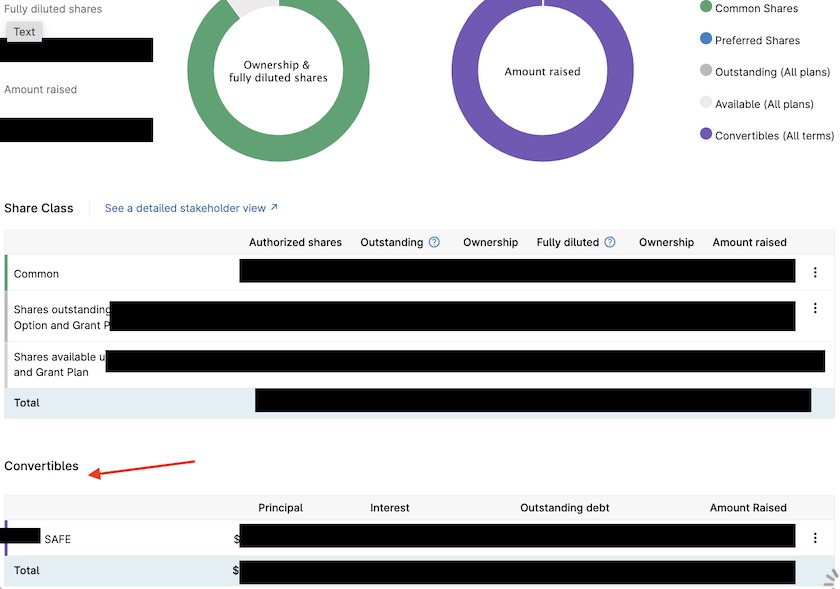
Yes. SAFEs are part of the ownership picture and should be reflected on the cap table, even before they convert into actual shares. Until conversion, SAFEs are usually shown in a separate section of the cap table (for example, “Convertible Securities” or “SAFEs”), with the key economic terms such as valuation cap, discount, and investment amount so investors can understand the fully diluted impact.
Once a SAFE converts in a priced round, it comes off the SAFEs section of the cap table and the resulting shares move into the appropriate equity section (typically preferred stock). This makes it clear which investors have already converted into equity, which SAFEs are still outstanding, and how much potential dilution remains from unconverted SAFEs when you model future rounds.