
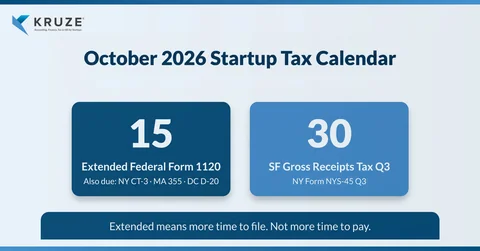
October is the final federal filing month for many startup C‑corps that extended their 2025 tax return. For calendar‑year corporations that timely filed Form 7004, the extended deadline to file federal Form 1120 is October 15, 2026. The same date is also the extended filing deadline for several state corporate returns, including New York Form CT‑3 and Utah Form TC‑20.
Kruze provides a full tax calendar for C-corps that you can download. In addition to federal tax deadlines, startup founders should also track local October obligations. For example, San Francisco’s third estimated Gross Receipts Tax installment is due October 30, while New York employers must generally file Q3 payroll taxes on Form NYS‑45 by October 30.
An extension gives your startup more time to file, not more time to pay. Any expected 2025 federal or state tax liability should have been paid by the original April deadline. Use October to finalize reconciled financials, validate R&D credit support, confirm multi-state tax positions, and file complete, investor-ready returns.
October 15: Extended federal Form 1120 deadline
For calendar-year C-corporations that filed Form 7004 by April 15, the extended federal filing deadline is October 15, 2026. Form 1120 reports a corporation’s income, deductions, credits, gains, losses, and resulting federal income-tax liability. All C-corps must file, including startups operating at a loss.
The October 15 deadline is especially important for startups that needed additional time to complete year-end bookkeeping, finalize a complex R&D credit study, reconcile equity transactions, or gather multi-state tax information. However, an extended return still needs to be complete and supportable. Before filing, confirm that:
- The 2025 balance sheet is reconciled to your general ledger and bank accounts.
- Revenue recognition, accrued expenses, and payroll liabilities are properly recorded.
- Your cap table, stock issuances, option grants, and financing transactions are reflected accurately.
- Federal and state estimated payments are applied correctly.
- Your return incorporates any eligible credits, deductions, and carryforwards.
- The tax return agrees with the financial statements your investors, lenders, or acquirers may review.
For startups planning a fundraise, acquisition, or diligence process, a clean and timely tax filing helps avoid the kind of compliance gaps that can create unnecessary questions later.
State returns often share the October 15 deadline
Many state corporate tax filings follow the federal extension calendar, but the details vary by jurisdiction. Startups should not assume that a federal extension automatically handles a state return or that every state has the same form, payment requirements, or filing deadline.
Boston and Massachusetts startups
Massachusetts startups that extended their Massachusetts Corporation Excise Return, Form 355, must file it by October 15, 2026. This deadline applies alongside the extended federal Form 1120 filing date.
If your startup had Massachusetts corporate excise tax liability, make sure the return properly reflects Massachusetts apportionment, prior estimated payments, and any state-specific credits. Massachusetts estimated payments and the extended Form 355 filing are separate compliance requirements.
New York City startups
New York-based C-corps that extended their New York State General Business Corporation Franchise Tax Return, Form CT-3, must file by October 15, 2026. The same date is also the final deadline for the extended federal Form 1120.
New York returns can be particularly complex for venture-backed companies with employees, revenue, or customers across multiple jurisdictions. Review state and city allocations, estimated payments, and any applicable New York credits before filing.
New York City startups with employees should also calendar October 30, 2026, when the Quarterly New York State Payroll Taxes Form NYS-45 is due for the third quarter.
This quarterly filing generally covers New York State withholding and unemployment insurance reporting for July through September wages. Payroll providers may prepare the filing, but founders and finance teams should still verify that:
- Employee work locations are coded correctly.
- State withholding and unemployment tax liabilities reconcile to payroll records.
- Any notices from the New York State Department of Taxation and Finance or Department of Labor have been addressed.
- The return is filed and payment is remitted by the applicable deadline.
Washington, DC startups
For startups operating in Washington, DC, the extended DC Corporate Franchise Tax Return, Form D-20, is due October 15, 2026. This falls on the same date as the extended federal Form 1120.
DC startups should confirm that their franchise tax return matches the company’s federal tax return, includes all required District adjustments, and properly reflects estimated tax payments made during the year.
California startups
California corporate returns generally follow the federal extension schedule for calendar-year filers. Startups operating in San Francisco, Palo Alto, Mountain View, San Jose, San Diego, Santa Monica, or elsewhere in California should confirm that their California Form 100 filing is complete and that the minimum franchise tax, estimated payments, and any California-specific tax positions are accurately reflected.
Because California’s tax and filing requirements can vary by entity type, business activity, and nexus footprint, startups should work with a qualified tax advisor before relying on a federal extension date alone.
San Francisco: October 30 gross receipts installment
San Francisco has a city-specific tax payment that makes October more than just an extended-return month. For 2026, the Q3 Estimated San Francisco Gross Receipts Tax installment is due October 30.
This payment may apply to startups with San Francisco business activity and sufficient gross receipts, even if the company is unprofitable for federal income-tax purposes. San Francisco’s business tax system is based on gross receipts rather than net income, so a cash-burning company can still have a city tax obligation.
Before October 30, confirm:
- Whether your startup is registered to do business in San Francisco.
- Whether your business activity and revenue exceed the applicable filing or payment thresholds.
- How gross receipts should be sourced or allocated to San Francisco.
- Whether you have already made the first and second estimated installments due earlier in the year.
- That the city tax liability is included in your cash forecast and accrued correctly in your books.
Cities without a major October-specific deadline
For many other major startup hubs, including Austin, Dallas, Miami, Boston, Seattle, Atlanta, Chicago, Salt Lake City, Boulder/Denver, Mountain View, Palo Alto, San Jose, San Diego, and Santa Monica, the most broadly applicable October event is the October 15 extended federal return deadline and any corresponding state return deadline.
That does not mean there are no obligations in these locations. State payroll, sales and use tax, business license, property tax, and industry-specific filings may still apply depending on your company’s employees, revenue, property, and nexus.
October 2026 checklist for startup founders
Use this checklist to keep October tax compliance on track:
- File your extended federal Form 1120 by October 15 if your startup filed Form 7004 in April.
- File corresponding extended state returns by their applicable deadlines, including Massachusetts Form 355, New York Form CT-3, and DC Form D-20 where relevant.
- Confirm that all tax payments due with the original April filings were made; calculate and resolve any remaining balances, interest, or penalties.
- Review your R&D credit documentation and ensure eligible credits are accurately reported.
- If you operate in San Francisco, pay the Q3 estimated Gross Receipts Tax installment by October 30.
- If you have New York employees, file Q3 Form NYS-45 by October 30.
- Reconcile filed tax returns and payments in your accounting system, then update your year-end tax forecast before November and December deadlines.
Make October a diligence-ready deadline
The extended-return deadline is a natural checkpoint for startup finance teams. By October, your 2025 tax compliance should be closed, your 2026 estimated tax forecast should be refreshed, and your financial records should be ready for investors, lenders, or prospective acquirers.
Need help closing out extended returns? Kruze’s startup tax CPAs help venture-backed companies prepare federal and multi-state tax returns, manage R&D credits, and stay compliant as they scale.


