
For many venture‑backed companies, May looks like a quiet month – but from a startup accounting perspective, it is a key window to clean up your books and hit important state and local tax deadlines. Smart founders use May to stay ahead on startup accounting, especially in California hubs and Miami, so there are no surprises later in the year.
Why May matters for startup accounting
By May, most nationwide C‑corp and Delaware franchise deadlines are between cycles, which creates breathing room – but that’s exactly when city and state obligations can sneak up on busy founders. For strong startup accounting and compliance, Kruze recommends using May to:
- Confirm your April 15 federal and state corporate returns or extensions are filed.
- Verify your Delaware franchise tax filings and payments are on track.
- Shift attention to local property and state corporate income tax deadlines that fall in early May.
Treating these tasks as part of your ongoing startup accounting process keeps your financials due‑diligence ready for future fundraising.
California cities: May 7 Form 571‑L business property
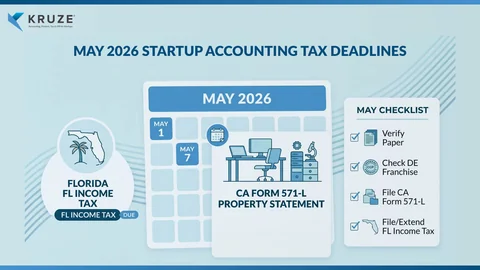
Across California startup hubs, early May is all about the Form 571‑L business property statement, which drives local property tax assessments. This filing shows up on city calendars for places like San Francisco, San Jose, Mountain View, and Santa Monica, and is a recurring part of good startup accounting in the state.
The Form 571‑L business property tax applies to a startup’s tangible business personal property, not its real estate. Counties use this annual statement to assess ad valorem property tax on items such as:
- Office furniture, desks, chairs, and fixtures.
- Computers, servers, networking gear, and other technology hardware.
- Machinery, lab and manufacturing equipment, and tools.
- Leasehold improvements and certain tenant build‑outs.
- Other supplies and business‑use equipment at each location as of the January 1 lien date.
Under California law, nearly all tangible business personal property is taxable unless specifically exempt, so Form 571‑L is the standardized statement startups file with the county assessor each year to report the cost of these assets. Missing the filing can trigger estimated assessments plus penalties, which then need to be reconciled in your startup accounting system and can distort your burn and runway reporting.
Florida: May 1 corporate income tax
Outside California, startups with Florida activity see an important May deadline on Kruze’s Miami startup tax compliance calendar. From a startup accounting standpoint, this date should be built into your recurring close checklist and modeled into your cash forecasts.
- May 1, 2026: Florida Corporate Income Tax Return due for Miami startups, with an option to extend the filing to November 1.
- Who it affects: Florida‑nexus C‑corps, including Delaware C‑corps with sufficient activity in Florida.
- Extensions: You can extend the return, but any tax owed must still be paid on time to avoid penalties and interest.
Integrating this May 1 payment into your startup accounting process helps you avoid last‑minute cash crunches and keeps your state tax liabilities aligned with your financial statements.
May 2026 startup accounting checklist
Here’s a founder‑friendly May checklist you can fold directly into your startup accounting workflows:
- Confirm your April 15 federal Form 1120 and state corporate returns (or extensions) were filed correctly and posted in your accounting system.
- If you operate in California, verify your county Form 571‑L business property statement is filed by May 7 to avoid 10% penalties, and make sure the related property tax accruals are recorded.
- If you have Florida nexus, file or extend your Florida Corporate Income Tax Return by May 1 and pay any expected tax due, then record the payment and liability in your books.
- Pull the latest 2026 tax compliance calendars or iCal integrations from Kruze’s startup resources hub so your internal startup accounting calendar captures all city‑specific dates you might otherwise miss.
By layering these city calendars on top of the main C‑corp tax deadline guide, you can turn May from a “quiet” month into a strategic window to tighten your startup accounting, stay ahead of property and state corporate compliance, and keep your financials investor‑ready.


