
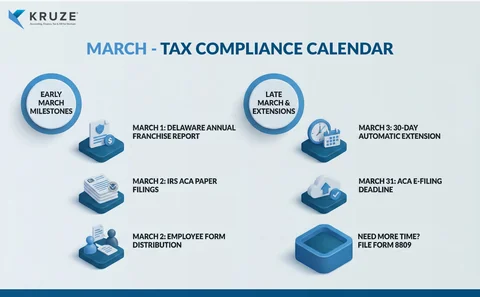
March brings several important tax and compliance deadlines for Delaware-incorporated and venture-backed startups. Missing these can lead to penalties or loss of good standing, so make sure you mark your calendar! For founders juggling fundraising, product, and hiring, these dates can sneak up quickly, which is why it helps to build a simple month-by-month compliance checklist and assign clear ownership to finance, HR, or your outside CPA. Treat these deadlines as part of your operational rhythm, just like board meetings and investor updates, so you are never scrambling at the last minute.
March 1, 2026: Delaware Annual Franchise Report
If your startup is a Delaware C-Corporation, your Delaware Annual Franchise Report and franchise tax payment are due by March 1. This filing is required even if you are pre‑revenue or barely using the entity. Many first‑time founders assume “no revenue = no tax,” but the franchise tax is essentially a fee for the privilege of being incorporated in Delaware, and it applies regardless of your income.
The minimum tax is $400, but if your company has raised significant capital or issued a large number of shares, that amount can increase substantially. Delaware uses different calculation methods, and the “default” method can make your tax bill look much higher than it needs to be. You can use our Delaware Franchise Tax Calculator to estimate the amount you owe and see how choosing a different calculation method may reduce your liability. Make sure you revisit this every year as your cap table changes.
Failure to file can result in your startup losing good standing with the state of Delaware, and that’s something investors and future acquirers will notice. Losing good standing can delay a funding round, block a merger or acquisition, or create unpleasant surprises during due diligence when lawyers run their standard corporate checks. Make sure someone on your team is responsible for monitoring Delaware notices and emails so you do not miss this critical annual requirement.
March 2, 2026: ACA Compliance Filings (Paper Filing)
Startups that offer health coverage to employees must handle Affordable Care Act (ACA) reporting, even if you only have a small team on your plan. These filings help the IRS track who had qualifying health coverage and whether employers met their obligations under the ACA’s employer mandate. If you’ve grown quickly or added benefits mid‑year, double‑check that your payroll or benefits platform is set up to generate these forms accurately.
Paper filings of Forms 1094-B, 1095-B, 1094-C, and 1095-C are due to the IRS by March 2. Many founders rely on their payroll provider, PEO, or benefits broker to prepare and send these filings, but the legal responsibility ultimately sits with the company, so you should confirm who is doing what and when. Ask for a status update a few weeks before the deadline so you have time to fix any data issues.
If you need more time, Form 8809 grants an automatic 30-day filing extension. This can be a lifesaver if you have incomplete payroll data, changed providers mid‑year, or discovered errors while reviewing draft forms. Keep in mind that an extension to file is not an extension to furnish forms to employees unless specifically allowed, so you still need a plan for employee communications.
Also by March 2, you must send Forms 1095-B and 1095-C to employees so they can report their coverage on their individual tax returns. Employees may not understand these forms, so it is helpful to send a brief explanation or FAQ along with the documents or direct them to your HR contact or broker for questions. Clear communication here reduces support tickets and keeps your team confident that their health coverage has been reported correctly.
March 3, 2026: IRS Automatic Extension Deadline
If you’ve requested an extension, March 3 is the extended deadline to provide Forms 1095-B and 1095-C to employees. This extra day gives some breathing room for HR or payroll teams finalizing data, especially if you had late enrollments, terminations, or corrections that affected coverage during the prior year.
Use this extra time to reconcile any discrepancies between your payroll system, benefits platform, and general ledger. A quick reconciliation, checking that covered employees, coverage dates, and employer contributions match across systems, can prevent frustration later if employees notice inconsistencies on their forms. For growing startups, this is also a good moment to evaluate whether your current HR/benefits infrastructure can keep up with your team size and hiring plans for the coming year.
March 31, 2026: ACA Compliance (E-Filing)
For startups filing electronically, e-file ACA Forms 1094-B, 1095-B, 1094-C, and 1095-C by March 31. Electronic filing is generally faster, more secure, and easier to track than mailing paper forms, and most modern payroll and benefits platforms are designed to transmit ACA data directly to the IRS. Make sure you have access to any required portals or credentials in advance so you are not rushing at the last minute.
The IRS requires e-filing for companies with 10 or more forms, so most startups will fall into this group. Even if you are under that threshold, e-filing is usually a best practice because it reduces the risk of lost mail and gives you electronic confirmation of receipt. After filing, save copies of transmitted forms and acceptance notices with your year‑end financial and HR records so they are easy to find if questions arise during an IRS inquiry, financing, or due diligence.
Don’t Miss Your Startup’s Tax Deadlines
Staying compliant with these March tax obligations keeps your startup in good legal standing and avoids IRS or state penalties. It also sends a strong signal to investors that your back office is organized, your books are reliable, and your leadership team takes governance seriously. Treating compliance as part of your operating system — not a one‑off fire drill — will pay off when you go to raise your next round or negotiate an exit.
Kruze Consulting’s startup tax team can guide you through the tax filing process. We help venture-backed companies manage these recurring obligations, coordinate with payroll and benefits providers, and clean up prior‑year issues when something was missed. And Kruze has tax calendars with the dates for both federal tax deadlines and the deadlines for many states and cities. You can review and download them to your calendar, so your team always knows what’s coming up next.


