
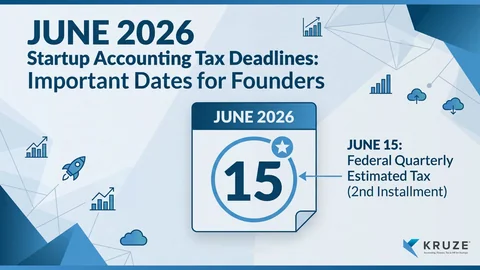
June is a pivotal mid‑year month for startup tax compliance, especially for profitable C‑corps and venture‑backed companies operating in multiple states. This guide outlines the core federal June deadline for startups and highlights notable state and local dates that affect startups in major U.S. hubs.
Federal: June 15 estimated tax for C‑corps
For calendar‑year C‑corporations, the second quarterly estimated federal income tax payment is due in mid‑June:
- June 15, 2026: Second‑quarter 2026 estimated income tax payment due for calendar‑year corporations, covering income from April 1 through May 31.
Profitable startups, or those expecting to be profitable in 2026, should work with their tax advisor to project taxable income and make sure the June payment is accurate to avoid underpayment penalties. Even if your startup is currently burning cash, it’s important to revisit this each year in case your profitability profile changes after a funding round or revenue growth.
Austin: Delaware franchise estimates and federal estimates
Startups in Austin generally follow Texas rules (no state corporate income tax) but still face Delaware and federal obligations if they are Delaware C‑corps. In June 2026, key items include:
- Early June: For corporations with high Delaware franchise tax liability (over $5,000 annually), a quarterly estimated Delaware franchise tax payment of 40% of the estimated annual tax is due on the first day of the month.
- June 15: Federal second‑quarter estimated corporate income tax payment for profitable C‑corps.
Because Texas does not impose a traditional state corporate income tax, the focus for Austin startups in June is on federal and Delaware payments, plus any industry‑specific local obligations that may apply.
New York City: Combined state and federal focus
New York City startups must juggle federal corporate estimated payments, New York State corporate taxes, and New York City business taxes over the course of the year. In June 2026, the primary recurring date most VC‑backed startups see is:
- June 15: Federal second‑quarter estimated corporate income tax payment for calendar‑year C‑corps.
New York State and City have more concentrated business and corporate tax filings earlier in the year (for example, March and April due dates for returns and annual reports), while June is mainly about federal estimates for most early‑stage startups.
San Francisco and California hubs
California startups in cities like San Francisco, Palo Alto, Mountain View, Santa Monica, San Jose, and San Diego face a mix of state‑level corporate and franchise taxes plus local property and business obligations.
By June, most of the heavy local filing – such as San Francisco business registration and gross receipts tax filings, and California business property statements – has already hit in March and early May. The primary recurring June item for California startups is:
- June 15, 2026: Second‑quarter estimated income tax payments at both the federal level and, for profitable California C‑corps, California estimated corporate income tax payments.
California’s Franchise Tax Board follows a similar quarterly estimated schedule (April 15, June 15, September 15, and the following January 15) for corporations with sufficient tax liability. Startups in San Francisco, Palo Alto, Mountain View, Santa Monica, San Jose, and San Diego should treat June 15 as a coordinated estimated tax date for both federal and California state income taxes if they expect taxable income.
Miami: Florida estimated corporate tax timing
For Florida‑nexus startups, including those with operations in Miami, Florida corporate income/franchise tax rules also require estimated tax payments when the expected state tax liability exceeds a threshold.
Florida’s Department of Revenue notes that calendar‑year C‑corps typically make estimated corporate income/franchise tax payments on the last day of the 5th, 6th, 9th month, and on the last day of the tax year. For a calendar‑year startup, that means:
- A late‑May installment (end of the 5th month), and
- A late‑June installment (end of the 6th month).
In practice, founders should confirm exact Florida estimated tax dates with their tax advisor or the Florida Department of Revenue, and align those payments with the June federal estimated tax deadline. Cash‑burning startups may not meet the threshold for Florida estimates, but once they do, these late‑May and late‑June state payments become part of the June planning window.
Dallas, Chicago, Boston, Seattle, DC, Atlanta, Salt Lake City, Boulder/Denver
In many other U.S. startup hubs, June is similarly dominated by federal estimated tax and, where relevant, state corporate estimated payments. Across cities such as Dallas, Chicago, Boston, Seattle, Washington DC, Atlanta, Salt Lake City, and Boulder/Denver, the key June pattern for C‑corp startups is:
- June 15, 2026: Second‑quarter federal estimated corporate income tax payment for calendar‑year C‑corps.
- State‑level estimated payments (where applicable) that follow a similar quarterly schedule – often April 15, June 15, September 15, and the following January 15 – for corporations with sufficient taxable income in that state.
For many early‑stage startups that are not yet profitable, these estimated payments may not be required, but once taxable income appears, June becomes an important anchor date for both federal and state estimates.
June 2026 startup tax checklist
Here is a founder‑friendly June checklist derived from federal rules and common state patterns for C‑corp startups:
- Confirm whether your startup expects taxable income in 2026; if yes, calculate and pay the federal second‑quarter estimated tax by June 15.
- If your startup is subject to state corporate income or franchise tax (for example, in California or New York), check whether a June 15 state estimated payment is due as well.
- If you are a Delaware C‑corp with high expected Delaware franchise tax (over $5,000 annually), determine whether you need a June estimated franchise tax installment and coordinate it with your June planning.
- If you have Florida nexus, confirm with your tax advisor whether your expected Florida corporate income/franchise tax liability requires estimated payments, and plan for the late‑May and late‑June installments that fall into your June cash planning window.
Treating June as a coordinated estimated‑tax month – rather than just another page on the calendar – helps startups avoid underpayment penalties, smooth cash outflows, and keep their financials investor‑ready going into the second half of the year. Get the 2026 tax compliance calendars or iCal integrations from Kruze so your startup accounting calendar captures all city‑specific dates you might otherwise miss.


