
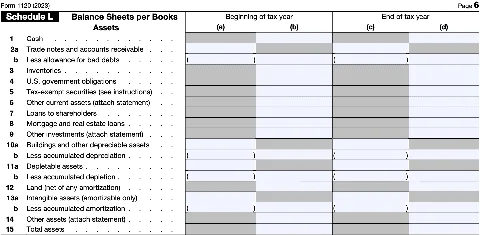
Understanding IRS Form 1120 Schedule L
Schedule L is a key component of IRS Form 1120, the annual income tax return that C corporations file with the IRS. It gives the IRS a clear view of a corporation’s financial health by detailing its assets, liabilities, and shareholder equity, providing a financial snapshot of the company.
Filing Schedule L accurately and on time is essential for complying with IRS regulations and helps corporations monitor their financial stability. Visit our guide to Startup Tax Forms to find out more information about other IRS forms startups need.
Schedule L, or “Balance Sheets per Books,” requires corporations to report their balance sheet data exactly as it appears in their records. This section follows standard accounting principles, meaning the information provided reflects the company’s actual financial standing, not just numbers generated for the tax return.
Schedule L is a useful tool for keeping accurate financial records that meet IRS requirements and give a clear picture of a company’s financial health.
Filing correctly is about more than just checking boxes, so make sure your Schedule L is accurate and audit-ready with Kruze’s Startup Tax Services.
What Is The Purpose of the Form 1120 Schedule L
A corporation’s balance sheet offers a clear snapshot of its financial health by listing everything it owns (assets), what it owes (liabilities), and the remaining value shareholders hold (equity).
This breakdown, which appears on Schedule L of Form 1120, captures the company’s financial position at the beginning and end of the tax year.
Completing Schedule L helps corporations make sure their tax filings reflect their actual finances and gives them a clear overview of their assets, liabilities, and shareholder investments.
For the IRS, Schedule L verifies that reported income and deductions reflect reality. Whether the company follows cash or accrual accounting will change the individual line items, but Schedule L must still reconcile to the corporation’s underlying books.
Keep in mind, that it’s best to complete Schedule L (Balance Sheet) before Schedule M-1 (Reconciliation of Income (Loss) per Books With Income per Return) or Schedule M-2 (Analysis of Unappropriated Retained Earnings per Books (Schedule L, Line 25), as items on these schedules reconcile with the balance sheet.
Who Has To Complete Schedule L
For C corporations filing Form 1120, Schedule L is required unless the corporation qualifies for the “small corporation” exception. In general, a C corporation does not have to complete Schedule L if both its total receipts and its total assets at the end of the tax year are less than $250,000.
Corporations that do not meet the small‑corporation exception must complete Schedule L, regardless of whether they are newly formed or foreign‑owned. This ensures the IRS gets a complete financial picture whenever a balance sheet is required with Form 1120.
This ensures the IRS gets a complete financial picture, even for companies that are new or based outside the U.S.
Smaller C corporations have more flexibility. Those with both total receipts and year‑end total assets under $250,000 are generally exempt from filing Schedule L, as long as they meet the small‑corporation criteria outlined in the Form 1120 instructions and indicate this appropriately on their return. This exemption helps smaller companies avoid preparing a detailed balance sheet and additional forms if their finances are below the set threshold.
Additional requirements apply to larger corporations with total assets of $10 million or more. These companies generally must file Schedule M‑3 instead of Schedule M‑1, and the Form 1120 instructions explain how Schedule M‑3 and Schedule L need to tie together so that the balance sheet and book‑to‑tax reconciliation remain consistent.
Schedule L Instructions
We strongly recommend working with an experienced tax preparer for personalized advice on filling out Schedule L, which is just one part of the corporate income tax return, Form 1120.
For calendar‑year C corporations, Form 1120 (and therefore Schedule L) is generally due on April 15 of the following year, with an automatic six‑month extension to October 15 available by filing Form 7004. Due dates can shift slightly when April 15 falls on a weekend or holiday, so always confirm the current‑year calendar before filing.
You can also visit our C-Corporation tax deadlines calendar to see the current year deadlines.
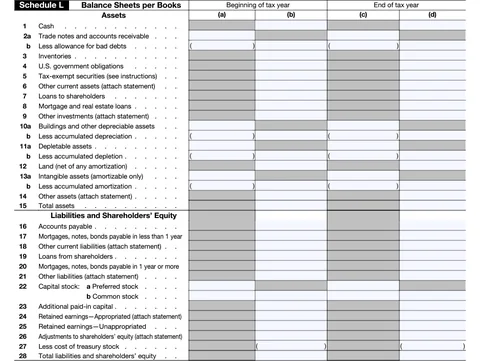
Here are high-level instructions on filling out Schedule L.
Step 1: Assets
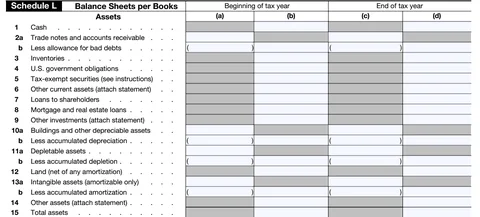
The Assets section of Schedule L is where all corporate assets are either entered directly or pulled from other sections. This allows users to record each type of asset, providing a detailed breakdown to ensure accurate reporting on the Balance Sheet in Schedule L.
The section includes items such as cash, accounts receivable, inventories, and investments, among others, along with supporting details and adjustments.
- Cash: The beginning and ending balances of all cash accounts in Column (b) and Column (d).
- Trade notes and accounts receivable: Unpaid amounts due from clients; requires details for accrual-based reporting.
- Less allowance for bad debts: Adjustments for uncollectible accounts receivable.
- Inventories: This number is pulled from Form 1125-A, adjustments affect both the Schedule L and Form 1125-A.
- U.S. government obligations: Any treasury notes or U.S. bonds owned by the corporation.
- Tax-exempt securities: Includes tax-exempt investments like municipal bonds.
- Other current assets: Additional current assets, itemized separately.
- Loans to shareholders: Balances of loans to shareholders or relatives.
- Mortgage and real estate loans: Mortgage or real estate loans to third parties.
- Other investments: Additional investments not listed above, itemized separately.
- Buildings and other depreciable assets: The beginning cost or original basis for any buildings or depreciable property (like vehicles and machinery) used in the corporation’s business, unless it’s automatically pulled from last year’s return.
- Less accumulated depreciation: Total depreciation for assets, aligned with Form 4562.
- Depletable assets: Beginning and ending balances of assets subject to depletion.
- Less accumulated depletion: Depreciation for depletable assets.
- Land (net of any amortization): Corporate-owned land.
- Intangible assets (amortizable only): Assets subject to amortization, pulled from other tax sections.
- Less accumulated amortization: Total amortization for intangible assets.
- Other assets: Miscellaneous assets not covered in previous categories.
- Total assets: Sum of all entries in the Assets section of Schedule L.
Step 2: Liabilities and Shareholders’ Equity
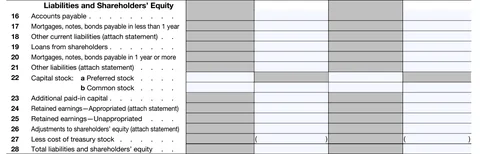
The Liabilities and Shareholders’ Equity section of Schedule L is where all corporate liabilities and shareholder equity accounts are recorded. While only beginning balances pull automatically from the previous year’s return, each item requires entry for accurate financial reporting on Schedule L.
This section includes details on accounts payable, loans, capital stock, retained earnings, and adjustments, among other items, providing a comprehensive view of the corporation’s liabilities and equity.
- Accounts payable: Amount owed to vendors for purchases on credit.
- Mortgages, notes, bonds payable in less than 1 year: Balances on loans due within the next 12 months.
- Other current liabilities: Itemize any liabilities due within the year not listed above, on Line 18, with an attached supporting statement.
- Loans from shareholders: Balances on loans from shareholders or relatives, with optional supporting details.
- Mortgages, notes, bonds payable in 1 year or more: Balances on loans due beyond the next 12 months.
- Other liabilities: Itemize any long-term liabilities not previously listed, with a supporting statement.
- Capital stock: Total book value of issued common and preferred stock, based on par value.
- Additional paid-in capital: Additional shareholder contributions above par value.
- Retained earnings—Appropriated: Accumulated, undistributed earnings, adjusted from Schedule M-2.
- Retained earnings—Unappropriated: Any adjustments needed to line 24. Generally, these adjustments should be made on M-2 if possible, rather than on line 25.
- Adjustments to shareholders’ equity: Itemize any equity adjustments not covered in Schedule M-2, for example, unrealized gains or foreign currency adjustments.
- Less cost of treasury stock: Value of repurchased stock, reducing total equity.
- Total liabilities and shareholders’ equity: The calculated total of all entries in the Liabilities and Equity section. This should match the Total Assets on Line 15.
Take full advantage of tax benefits for your startup
If you need help with startup tax planning, including general business credits, Form 1120, and whether you need to file a tax return at all, reach out to Kruze Consulting for help. We are experts at tax credits for startups.


