Big Tax Changes for Startups! The new tax bill could impact your startup. What should you do next?  Read the Blog →
Kruze Consulting Navbar Logo
  • (415) 322-1610
  • Contact Us
  • Accounting & Bookkeeping
    Name
    Startup Accounting

    Maximize Your Startup’s Potential

    Name
    Startup Bookkeeping

    Services for High-Growth Startups

    Name
    Strategic Financial Accounting

    Strategic Accounting Boosts Your VC-Funded Startup’s Financial Future

    Tax Services
    Name
    Startup Tax Services

    Tax Services for VC-Backed Startups

    Name
    Startup Tax Returns

    Filing Tax Returns for VC-Backed Startups

    Name
    Delaware Franchise Tax

    Calculate Your Delaware Franchise Tax

    R&D Tax Credits
    Name
    R&D Tax Credits

    Unlock Your Startup’s R&D Tax Credit Potential

    Name
    R&D Tax Calculator

    How much can your startup save in payroll taxes?

    Advisory services
    Fractional CFO & Advisory

    VC Due Diligence

    Startup M&A Accounting

    Financial Modeling Services

    409A Valuations Services

    Part-Time CFOs Services

  • Pricing
  • Name
    About Us

    Learn more about Kruze Consulting

    Name
    Partners

    Our partners are the best in the business

    Name
    Reviews

    See what our clients say about us

    Name
    Careers

    Join our team of startup accounting experts

    Name
    Announcements

    All press mentions, releases, and news

  • Early-Stage Tax Tips

    Guide to Seed Stage Tax Returns

    Do unprofitable companies need to file tax returns? Yes! Read our tips now.

    Guide to Seed Stage Tax Returns

    Knowledge base

    Name
    Startup Q&A

    Answers to hundreds of startup accounting, finance, HR and tax Q's

    Name
    Blog

    Expert startup accounting advice (and more)

    Name
    Case Studies

    See how we helped our clients save money and grow their businesses

    Top Financial Tips and Resources for Startups

    Name
    Startup Financial Health Tools

    Tips for setting up scaleable financial systems

    Name
    Free Financial Models

    Free to download financial models

    Name
    C-Corp Tax Deadlines

    iCals with federal, state and local compliance deadlines

    Name
    Best VC Pitch Decks

    See more of the best pitch decks ever used

    Name
    CEO Salary Report

    Data on what CEOs are paid

    Name
    Best Startup Credit Cards

    After working with hundreds of startups, we picked the best credit cards

  • (415) 322-1610
  • Contact Us
  1. Home
  2. Blog
  3. Form 1120 Schedule M-2

IRS Form 1120 Schedule M-2: Analysis of Unappropriated Retained Earnings per Books

by
Kruze Consulting Kruze Consulting

Kruze Consulting

Published: December 10, 2024

IRS Form 1120 Schedule M-2

Understanding IRS Schedule M-2

Schedule M-2 is an important part of IRS Form 1120, the annual tax form corporations file with the IRS.

Master your retained earnings reconciliation and streamline your corporate filing with Kruze’s expert Startup Tax Returns services.

Kruze logo

It is a key part of corporate tax reporting that shows changes in a company’s retained earnings from the start to the end of the tax year. It helps shareholders and the IRS understand important details, such as calculating a shareholder’s basis, handling dividends, and accounting for previously taxed income.

Schedule M-2 ties the unappropriated retained earnings shown on the company’s beginning and end-of-year balance sheets, as listed on Schedule L, and can also serve as a statement of retained earnings for financial reporting.

What Is The Purpose of Schedule M-2

In addition to reconciling financial net income to taxable income on Schedule M-1, corporations are typically required to complete Schedule M-2 to analyze unappropriated retained earnings.

Schedule M-2 is essential for businesses because it shows how much money is available that isn’t reserved for specific uses.

In recent years, it has become even more significant as a place to report non-taxable income, such as forgiven loans from the Paycheck Protection Program (PPP). Schedule M-2 provides a clear record of changes in retained earnings, helping businesses report accurately and maintain transparency in their financial records.

Who Has To Complete Schedule M-2

Similar to Schedule M-1, a corporation’s asset and receipt levels determine whether Schedule M-2 is required.

Corporations with total receipts and year-end assets under $250,000 can skip Schedules L, M-1, and M-2 if they’ve checked “Yes” on Schedule K, question 13.

Keep in mind, do not file Schedules M-1 and M-2 (Form 1120-F) if the corporation’s total assets at the end of the tax year are less than $25,000 (as shown on line 17, column (d) of Schedule L).

Schedule M-2 Instructions

We strongly recommend working with an experienced tax preparer for personalized advice on filling out Schedule M-2, which is just one part of the corporate income tax return, Form 1120. While Form 1120 is due April 15, it can be extended until Oct. 15 by filing Form 7004.

You can also visit our C-Corporation tax deadlines calendar to see the current year deadlines.
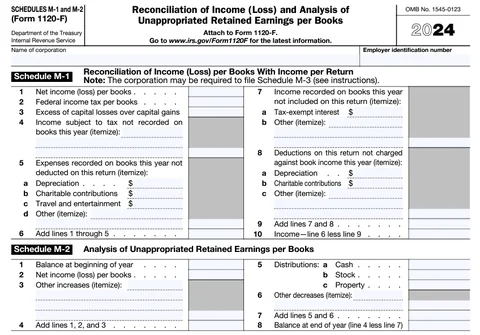
IRS Form 1120 Schedule M-1 and M-2

Here are high-level instructions on filling out Schedule M-2.

Schedule M-2 on Form 1120 is used to reconcile the corporation’s retained earnings from the beginning to the end of the tax year. It provides a clear picture of changes in retained earnings by detailing net income, distributions, and other adjustments. Below is a step-by-step guide to completing each line of Schedule M-2:

  • Balance at beginning of year: Enter the corporation’s balance of retained earnings at the beginning of the year.
  • Net income (loss) per books: Record the net income (or loss) as shown in the corporation’s financial books.
  • Other increases (itemize): Itemize and enter any other increases, such as tax-exempt interest income or life insurance proceeds from a life insurance policy.
  • Add lines 1, 2, and 3: Add the amounts from Lines 1, 2, and 3, and enter the total.
  • Distributions - 5a, 5b, 5c: Report distributions made during the year, with cash distributions on Line 5a, stock distributions on Line 5b, and property distributions on Line 5c.
  • Other decreases (itemize): Enter any other decreases, such as non-deductible meals and entertainment expenses or premiums paid for officers’ life insurance policies.
  • Add lines 5 and 6: Add the amounts from Lines 5 and 6.
  • Balance at end of year (line 4 less line 7): Subtract the total on Line 7 from the total on Line 4 to calculate the corporation’s retained earnings at the end of the year.

Keep In Mind with PPP Loans:

If a corporation reports tax-exempt income from a PPP loan before the loan forgiveness is finalized and the forgiveness amount turns out to be less than originally reported, adjustments may be necessary. The corporation must record the difference as a reduction in tax-exempt income on Schedule M-2, line 6, for the year it is notified of the partial forgiveness. This ensures the corporation’s records are accurate and comply with tax rules.

The corporation also needs to attach a statement to Schedule M-2 to explain the adjustment. The statement should include the corporation’s name, address, and EIN; a note confirming that the adjustment follows section 3.03 of Revenue Procedure 2021-48; and details about the original tax-exempt income, including the tax year it was reported, the amount originally recorded, and the adjusted amount. This ensures transparency and helps the IRS understand how the corporation calculated its updated tax-exempt income.

Take full advantage of tax benefits for your startup

If you need help with startup tax planning, including general business credits, Form 1120, and whether you need to file a tax return at all, reach out to Kruze Consulting for help. We are experts at tax credits for startups.

Get In Touch

Categories: Tax Forms.

Previous Post
Form 1120 Schedule K: Other Information
Next Post
Financial modeling for startups: Scenario analysis

Contact Us for a Free Consultation

Get the information you need

Startup CEO Salary Calculator

US Based Companies that have raised under $125M

  Redirecting to results  

Top Articles

  • Pre-Seed Funding + Top 20 Funds
  • eCommerce Accounting
  • Accounts Receivable Loans
  • What is the 2% and 20% VC fee structure?
  • How much does a 409A valuation cost?
  • What are Your VC’s Return Expectations Depending on the Stage of Investment?
  • Fractional CFOS
Kruze on X
Email Us
RSS

How much can your startup save in payroll taxes?

Estimate your R&D tax credit using our free calculator.

r&d tax calculator

Popular pages

  • SaaS accounting 101
  • Best accounting software
  • Top banks for startups
  • How to account for convertible note
  • Average CEO Pay
  • Startup Tax Returns
  • Best VC Pitch Decks
Also read:
How do FATCA and Form W-8 apply to startups?

How do FATCA and Form W-8 apply to startups?

Avoid costly FATCA withholding—learn which W-8 form your foreign contractors, vendors, or investors need and how startups stay compliant.
Wed, 9 August 2023

Kruze is a leader in accounting services for startups

With over $15 billion in funding raised by our clients, Kruze is a leader in helping funded startups with accounting, tax, finance and HR strategies.

Thank you!

✅ Your request has been submitted.
We will contact you shortly.

Enter your name
Enter Company name
Enter Phone number
Enter Email
Enter Message
 
By clicking Contact Us, you consent to receive automated messages from Kruze Consulting. Reply STOP to opt out. Terms of Service | Privacy Policy.

Kruze Consulting Logo Kruze Consulting

Kruze Consulting is a licensed CPA firm; California Board of Accountancy license number 7637

Inc.5000 logo

7 Years Straight – Inc. 5000 Fastest Growing Companies.

  • Team
  • Pricing
  • Careers
  • Kruze News
  • Reviews
  • Contact Us
  • Security
  • Privacy Policy
  • Terms of Service

Copyright © Kruze Consulting 2026

We may monetize some of our links through affiliate advertising. At any moment, executives or team members may own public or private stock in any of the third party companies we mention.

Do Not Sell or Share My Personal Information

Resources

  • Startup Resources
  • Startup Q&A
  • Case Studies
  • Kruze Blog
  • C-Corp Tax Deadlines
  • Startup Accounting Dictionary

Free Tax Calculators

  • Startup R&D Tax Credit Calculator
  • How Much Does a Startup Tax Return Cost?
  • Delaware Franchise Tax Calculator
  • Burn Rate and Cash Runway Calculator

Startup Tips

  • Startup Expense Management 101
  • 10 Best Banks For Startups in 2026
  • Startup Payroll
  • Best Accounting Software for Startups
  • Startup Tax Compliance
  • How to Pay International Employees & Contractors
  • Startup Bill Pay Service

Locations

  • Austin
  • New York City
  • San Francisco
  • San Jose
  • Santa Monica

Social Media

  • Kruze Consulting on Youtube
  • Kruze Consulting on LinkedIn
  • Kruze Consulting on Twitter
  • Kruze Consulting on Yelp

Industry Expertise

  • SaaS Accounting
  • Biotech Accounting
  • AI Startup Accounting
  • eCommerce Accounting
  • Hardware Accountants
  • CPG Accountants
  • Crypto Accounting
  • Healthcare Accounting
  • Startup Accounting
  Talk to a leading startup CPA
  • Is the content on this page useful?

Thank you!

Your feedback is very important.

Loading search...

Initializing search...

Search

Recent searches: