
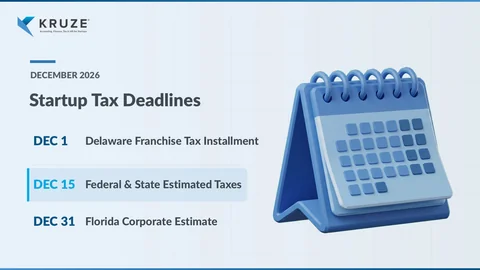
December brings three important tax dates for startup finance teams: December 1 for qualifying Delaware franchise tax installments, December 15 for federal and several state corporate estimated tax payments, and December 31 for Florida’s final calendar-year corporate estimate. Which payments apply depends on your startup’s incorporation, tax liability, and state and local footprint, not simply where its headquarters is located.
For venture-backed companies, December is also the time to compare full-year projections with actual results. Before scheduling payments, review your estimated tax calculations, confirm earlier installments, and make sure year-end cash forecasts include every applicable jurisdiction.
December 2026 startup tax deadlines at a glance
These dates generally apply to calendar-year C-corps. Fiscal-year companies, short-year filers, and businesses eligible for special relief may have different requirements.
| Due date | Tax obligation | Who should review it |
|---|---|---|
| December 1 | Delaware estimated franchise tax installment: 20% of estimated annual tax | Delaware corporations with annual franchise tax of $5,000 or more. |
| December 15 | Fourth federal corporate estimated income tax installment | Calendar-year C-corps required to make federal estimated payments. |
| December 15 | California corporate estimated tax installment | Calendar-year corporations with California estimated tax obligations. |
| December 15 | Massachusetts fourth corporate estimated tax installment, Form 355-ES | Boston and other Massachusetts-nexus corporations with estimated tax obligations. |
| December 15 | New York State and New York City fourth corporate estimated tax payments | Corporations with applicable state or city estimated tax obligations. |
| December 15 | DC fourth corporate estimated tax payment, Form D-20ES | Corporations subject to District of Columbia estimated tax requirements. |
| December 31 | Florida fourth corporate estimated income/franchise tax installment | Calendar-year corporations expecting Florida corporate income tax liability above $2,500. |
December 1: Delaware franchise tax installment
Delaware corporations with annual franchise tax of $5,000 or more must pay 20% of their estimated annual franchise tax by December 1, 2026. The remaining balance is due with the annual report on March 1.
This obligation follows your startup’s state of incorporation. A Delaware C-corp operating in Austin, Chicago, Atlanta, Seattle, or another startup hub should evaluate the Delaware requirement separately from taxes in its operating locations.
Do not assume that operating at a loss eliminates this payment. Delaware franchise tax is a separate obligation from federal corporate income tax. Before paying, review the company’s franchise tax calculation and confirm the amount of earlier installments.
Our Delaware Franchise Tax Calculator is a useful starting point for reviewing your startup’s estimated obligation with your tax advisor.
December 15: final federal corporate estimated tax installment
The fourth federal estimated income tax installment for calendar-year C-corps is due December 15, 2026. This is a current-year estimated payment, not the deadline to file your 2026 corporate income tax return.
For startups with estimated tax obligations, the final installment deserves a fresh calculation. A forecast prepared earlier in the year may no longer reflect the company’s revenue, deductible expenses, available credits, or prior payments.
Before scheduling the payment, have your tax team review:
- Year-to-date financial results and the December forecast.
- Expected taxable income, rather than cash flow alone.
- Available deductions, credits, and carryforwards.
- Estimated payments already made.
- Any significant transactions that could change the tax calculation.
The goal is to make a supported payment, not simply repeat the amount paid in September.
California startup hubs: December 15 corporate estimate
Startups with California corporate estimated tax obligations should review their December 15 payment alongside the federal estimate. California Form 100-ES sets the fourth installment deadline as the 15th day of the corporation’s 12th tax month, making December 15 the applicable date for calendar-year corporations.
This state requirement can affect companies operating in San Francisco, Palo Alto, Mountain View, San Jose, Santa Monica, and San Diego. It’s a California obligation, not a separate city income tax payment.
California’s standard corporate estimated tax schedule is uneven: 30% for the first installment, 40% for the second, no required third installment, and 30% for the fourth. Your tax advisor should confirm the calculation and any exceptions rather than assuming the California payment matches the federal amount.
Boston: December 15 Massachusetts corporate estimate
Boston startups with Massachusetts corporate estimated tax obligations should calendar December 15 for the fourth installment using Form 355-ES. Under the standard schedule identified in the Boston compliance guide, this installment is 10% of estimated annual tax.
That differs from an equal quarterly payment schedule. Confirm earlier payments and the updated annual estimate before determining the balance to remit.
New York City: December 15 state and city estimates
New York City startups may have two separate corporate estimated tax payments due December 15:
- New York State estimated corporate tax, using Form CT-400.
- New York City estimated corporate tax, using Form NYC-400.
These are separate from the federal payment. Your company may need to evaluate state and city obligations independently, based on its filing requirements and activity in each jurisdiction.
For multi-state startups, December is a useful checkpoint for reviewing revenue allocation, employee locations, and other changes that could affect the year-end tax calculation.
Washington, DC: December 15 corporate estimate
Corporations with District of Columbia estimated tax obligations must make their fourth estimated payment using Form D-20ES by December 15.
For DC startups, coordinate this payment with the federal estimate while keeping the calculations separate. Confirm that the projected District liability and prior payments are reflected accurately in the company’s cash forecast.
Miami: December 31 Florida corporate estimate
Miami startups and other calendar-year corporations with Florida tax obligations should review the final Florida estimated corporate income/franchise tax installment due December 31, 2026. Florida requires estimated payments when expected annual corporate income tax liability exceeds $2,500.
Florida generally requires four equal installments. Unlike the federal corporate estimate due December 15, the fourth Florida installment falls on the last day of the tax year.
For founders, the practical takeaway is straightforward: Completing the mid-December federal payment does not finish Florida’s estimated tax cycle. Schedule the state payment separately and confirm it has been accepted before closing the books.
December startup accounting checklist
Use this checklist to organize your year-end tax work:
- By December 1: Pay the Delaware franchise tax installment if your corporation meets the $5,000 annual threshold.
- By December 15: Make the required federal corporate estimated tax payment.
- By December 15: Complete applicable California, Massachusetts, New York State, New York City, and DC corporate estimates.ftb.ca+3
- By December 31: Make the final Florida corporate estimate if required.
- Reconcile payments: Match tax confirmations to your accounting records and retain supporting calculations.
- Review outstanding notices: Resolve discrepancies before they carry into another filing season.
- Prepare for year-end reporting: Confirm payroll records, vendor information, and financial statements are ready for the next round of filings.
These are selected deadlines, not an exhaustive list. Monthly payroll deposits, sales and use tax filings, and company-specific license or registration obligations may also apply. Review your startup’s complete footprint rather than relying only on its headquarters location.
Finish the year with a clearer tax picture
December tax compliance works best when it is connected to accurate startup accounting. Updated books give your tax team a stronger basis for estimating liabilities, reconciling payments, and preparing for the next filing season.
Need help closing out your startup’s year-end tax obligations? Kruze’s startup tax services team can help you evaluate upcoming payments and coordinate tax preparation with your financial reporting.


