Big Tax Changes for Startups! The new tax bill could impact your startup. What should you do next?  Read the Blog →
Kruze Consulting Navbar Logo
  • (415) 322-1610
  • Contact Us
  • Accounting & Bookkeeping
    Name
    Startup Accounting

    Maximize Your Startup’s Potential

    Name
    Startup Bookkeeping

    Services for High-Growth Startups

    Name
    Strategic Financial Accounting

    Strategic Accounting Boosts Your VC-Funded Startup’s Financial Future

    Tax Services
    Name
    Startup Tax Services

    Tax Services for VC-Backed Startups

    Name
    Startup Tax Returns

    Filing Tax Returns for VC-Backed Startups

    Name
    Delaware Franchise Tax

    Calculate Your Delaware Franchise Tax

    R&D Tax Credits
    Name
    R&D Tax Credits

    Unlock Your Startup’s R&D Tax Credit Potential

    Name
    R&D Tax Calculator

    How much can your startup save in payroll taxes?

    Advisory services
    Fractional CFO & Advisory

    VC Due Diligence

    Startup M&A Accounting

    Financial Modeling Services

    409A Valuations Services

  • Pricing
  • Name
    About Us

    Learn more about Kruze Consulting

    Name
    Partners

    Our partners are the best in the business

    Name
    Reviews

    See what our clients say about us

    Name
    Careers

    Join our team of startup accounting experts

    Name
    Announcements

    All press mentions, releases, and news

  • Early-Stage Tax Tips

    Guide to Seed Stage Tax Returns

    Do unprofitable companies need to file tax returns? Yes! Read our tips now.

    Guide to Seed Stage Tax Returns

    Knowledge base

    Name
    Startup Q&A

    Answers to hundreds of startup accounting, finance, HR and tax Q's

    Name
    Blog

    Expert startup accounting advice (and more)

    Name
    Case Studies

    See how we helped our clients save money and grow their businesses

    Top Financial Tips and Resources for Startups

    Name
    Startup Financial Health Tools

    Financial systems built to scale with your raise

    Name
    Free Financial Models

    CPA-reviewed models investors trust

    Name
    C-Corp Tax Deadlines

    Stay compliant, every jurisdiction

    Name
    Startup Tax Forms

    IRS filings, decoded for founders

    Name
    CEO Salary Report

    Benchmark comp against funded startups

    Name
    Best VC Pitch Decks

    The decks that closed real VC checks

    Name
    Best Startup Credit Cards

    Vetted for VC-backed spend

    Name
    Best Business Banks

    Where funded founders bank

  • (415) 322-1610
  • Contact Us
  1. Home
  2. Blog
  3. What are IRS Form W-8 and FATCA?

How do FATCA and Form W-8 apply to startups?

by
Kruze Consulting Kruze Consulting

Kruze Consulting

Last updated: August 9, 2023
Published: May 8, 2022

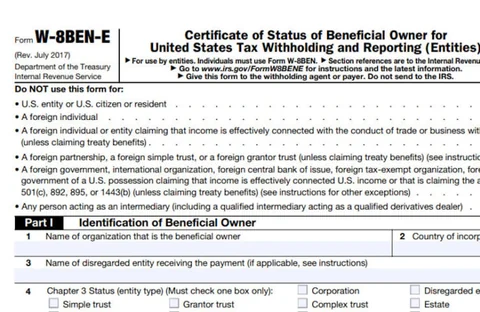
W-8BEN-E form

The Foreign Account Tax Compliance Act (FATCA) places significant tax filing requirements on startups with foreign assets, employees, and contractors, and that’s the reason for Form W-8.

FATCA is an extremely complex piece of legislation that was designed to fight tax evasion by Americans with financial assets held outside the U.S. Enacted in 2010, FATCA requires all U.S. taxpayers, even those living abroad, to report foreign assets to the IRS if they exceed specific thresholds.

In addition, foreign financial institutions (FFI) and non-financial foreign entities (NFFE) are required to report the assets of any American clients, or they’ll face a 30% withholding penalty on some payments from the U.S.

FATCA also establishes an individual or entity’s Chapter 4 status. Chapter 4 of the Internal Revenue Code is used to categorize U.S. residents that invest overseas, or foreign vendors that do business with U.S. companies.

Categories include U.S. person, specified U.S. person, foreign individual, participating FFI, deemed-compliant FFI, restricted distributor, exempt beneficial owner, nonparticipating FFI, territory financial institution, excepted NFFE, or passive NFFE.

Plenty of paperwork

With so many different Chapter 4 categories to document, the IRS developed a series of W-8 forms that are used to determine the relationships between your startup and overseas employees, contractors, and suppliers. The U.S. has income tax treaties with many foreign countries that state how much their citizens can be taxed.

Foreign entities or individuals must use a W-8 form to declare the type of income they earned, how they earned it, their countries of citizenship, and other factors that determine how they will be taxed.

This is when a startup needs a W-8

That means if you’re a startup that employs or pays non-resident aliens, you’ll need to have them complete a W-8 form.

Income is defined by the IRS as active or passive. Active income, earned from operating a business in the U.S. or providing services in the U.S. is called “effectively connected income” or ECI. Passive income includes interest, dividends, rent, or royalties, and is called “fixed or determinable annual or periodic income” or FDAP.

W-8 forms are only for foreign people and/or entities without citizenship or residency – US residents or resident aliens will not need W-8 forms.

Which W-8 forms do you need?

There are several W-8 forms that are used in different circumstances. Let’s look at the different types:

  • W-8BEN is for individuals to to claim foreign status or treaty benefits, or for royalties or other passive income.
  • W-8BEN-E is used by foreign entities, like businesses, to claim foreign status, treaty benefits, or document chapter 4 status.
  • W-8ECI is to be completed by payers to confirm that the income listed on the form is connected with a U.S. business or trade.
  • W-8EXP is used by foreign governments, foreign tax exempt organizations, foreign private foundations, governments of U.S. possessions, or foreign central banks to claim tax exempt status.
  • W-8IMY is for intermediaries, withholding foreign partnerships, withholding foreign trusts, and flow-through entities.

W-8 forms are valid for the year in which they are signed, and for three years after that. All W-8 forms must be sent to the payer or withholding agent before any income is paid to the non-U.S. individuals or entities. If not, the payer may have to withhold the full 30% tax rate that applies to foreign entities.

Talk to a professional tax consultant

There are a lot of rules connected to W-8 forms, and it’s easy to get confused. The W-8BEN-E, for example, has 30 sections, and not all of them apply to every business or entity.

Remember all those Chapter 4 statuses? It’s important to select the right status and complete the forms correctly to avoid any misunderstandings with the IRS. If you have questions about W-8 forms, or need assistance with them, please contact us. We’ll be happy to help.

Categories: Tax Forms, Startup Taxes, Tax Forms.
Tags: IRS Tax Forms.

Previous Post
How should startups account for crypto?
Next Post
Is your startup’s payroll blocked?

Contact Us for a Free Consultation

Get the information you need

Startup CEO Salary Calculator

US Based Companies that have raised under $125M

  Redirecting to results  

Top Articles

  • Pre-Seed Funding + Top 20 Funds
  • eCommerce Accounting
  • Accounts Receivable Loans
  • What is the 2% and 20% VC fee structure?
  • How much does a 409A valuation cost?
  • What are Your VC’s Return Expectations Depending on the Stage of Investment?
  • Fractional CFOS
Kruze on LinkedIn
Kruze on Reddit
Email Us
RSS

How much can your startup save in payroll taxes?

Estimate your R&D tax credit using our free calculator.

r&d tax calculator

Popular pages

  • SaaS accounting 101
  • Best accounting software
  • Top banks for startups
  • How to account for convertible note
  • Average CEO Pay
  • Startup Tax Returns
  • Best VC Pitch Decks
Related content:
IRS Form 1120 Schedule M-2: Analysis of Unappropriated Retained Earnings per Books
Tue, 10 December 2024
Form 1120 Schedule K: Other Information
Tue, 10 December 2024
Form 1120 Schedule M-1: Reconciliation of Income (Loss)
Mon, 9 December 2024
Form 1120 Schedule L: Balance Sheet per Books
Tue, 9 June 2026
Also read:
IRS Form 1120 Schedule M-2: Analysis of Unappropriated Retained Earnings per Books

IRS Form 1120 Schedule M-2: Analysis of Unappropriated Retained Earnings per Books

Understand Schedule M-2—learn how C-corps track retained earnings and why it matters for clean tax filings and due diligence.
Tue, 10 December 2024
Form 1120 Schedule K: Other Information

Form 1120 Schedule K: Other Information

Complete Form 1120 Schedule K correctly—learn what it reports, how it ties to corporate tax filings, and where startups make mistakes.
Tue, 10 December 2024
Form 1120 Schedule M-1: Reconciliation of Income (Loss)

Form 1120 Schedule M-1: Reconciliation of Income (Loss)

Demystify Schedule M-1—learn how C-corps reconcile book income to taxable income and avoid common tax return errors before filing under pressure.
Mon, 9 December 2024
Form 1120 Schedule L: Balance Sheet per Books

Form 1120 Schedule L: Balance Sheet per Books

Complete Form 1120 Schedule L—learn how to report your C-corp balance sheet on the tax return and avoid mismatches with your books.
Tue, 9 June 2026

Kruze is a leader in accounting services for startups

With over $15 billion in funding raised by our clients, Kruze is a leader in helping funded startups with accounting, tax, finance and HR strategies.

Thank you!

✅ Your request has been submitted.
We will contact you shortly.

Enter your name
Enter Company name
Enter Phone number
Enter Email
Enter Message
 
By clicking Contact Us, you consent to receive automated messages from Kruze Consulting. Reply STOP to opt out. Terms of Service | Privacy Policy.
  • Tax Resources

  • Startup Taxes
  • Startup Tax Deadlines
  • Startup Tax Returns 101
  • QSBS
  • Sales Tax 101
  • California Startup Taxes
  • Tax Credits

  • Startup Tax Credits
  • Research Tax Credit
  • California R&D Tax Credit
  • 401(k) Tax Credit
  • California Sales Tax Exemption
  • R&D Tax Credit Accounting
  • Tax Calculators

  • Tax Return Calculator
  • R&D Tax Credit Calculator
  • DE Franchise Tax Calculator
  • 83(B) ELECTION Form
  • Burn Rate Calculator
  • Rule of 40 Formula
  • Tax Form Help

  • Form 1120
  • Form 6765
  • Startup 1099 Forms
  • W-8BEN
  • Form 5471
  • Form 5472

Kruze Consulting Logo Kruze Consulting

Kruze Consulting is a licensed CPA firm; California Board of Accountancy license number 7637

Inc.5000 logo

7 Years Straight – Inc. 5000 Fastest Growing Companies.

  • Team
  • Pricing
  • Careers
  • Kruze News
  • Reviews
  • Contact Us
  • Security
  • Privacy Policy
  • Terms of Service

Copyright © Kruze Consulting 2026

We may monetize some of our links through affiliate advertising. At any moment, executives or team members may own public or private stock in any of the third party companies we mention.

Do Not Sell or Share My Personal Information

Resources

  • Startup Resources
  • Startup Q&A
  • Case Studies
  • Kruze Blog
  • C-Corp Tax Deadlines
  • Startup Accounting Dictionary

Free Tax Calculators

  • Startup R&D Tax Credit Calculator
  • How Much Does a Startup Tax Return Cost?
  • Delaware Franchise Tax Calculator
  • Burn Rate and Cash Runway Calculator

Startup Tips

  • Startup Expense Management 101
  • 10 Best Banks For Startups in 2026
  • Startup Payroll
  • Best Accounting Software for Startups
  • Startup Tax Compliance
  • How to Pay International Employees & Contractors
  • Startup Bill Pay Service

Locations

  • Austin
  • New York City
  • San Francisco
  • San Jose
  • Santa Monica

Social Media

  • Kruze Consulting on Youtube
  • Kruze Consulting on LinkedIn
  • Kruze Consulting on Twitter
  • Kruze Consulting on Yelp

Industry Expertise

  • SaaS Accounting
  • Biotech Accounting
  • AI Startup Accounting
  • eCommerce Accounting
  • Hardware Accountants
  • CPG Accountants
  • Crypto Accounting
  • Healthcare Accounting
  • Startup Accounting
  Talk to a leading startup CPA
  • Is the content on this page useful?

Thank you!

Your feedback is very important.

Loading search...

Initializing search...

Search

Recent searches: